A self-guided walk you can do today
You need no ticket to see Old Louisville. Its sidewalks and garden courts belong to everyone, and a circuit you can finish before lunch passes most of the landmarks the guided walks stop at. What you give up is the story behind each front door, and the route below is built to give some of it back.
Before you set off
Start at the Historic Old Louisville Visitors Center, a white stucco pavilion with a red tile roof inside Central Park at 1340 S 4th St. Its tourism listing says it hands out a free self-guided map, and drivers can leave the car in the lot behind the building. Check its opening hours before you count on the map or the restroom. If you arrive by bus or rideshare instead, getting there, parking and meeting points explains the options.
The loop below covers about 1.5–2 miles (2.5–3 km). Allow 1.5–2 hours at a stroll with photo stops, more if you linger in the courts. Wear flat, comfortable shoes, because the old brick sidewalks heave over tree roots. Summer afternoons are hot and humid, with highs in the upper 80s °F (about 31 °C), so carry water and walk in the morning if you can.
The route, stop by stop
- Central Park. About 17 acres that began as the DuPont family estate. It later formed part of the grounds of the Southern Exposition, and the Olmsted firm reshaped it in the early 1900s. The amphitheater hosts free Shakespeare on summer evenings;
- St. James Court and its fountain. The exhibition ran here from 1883 to 1887, and after it closed, St. James Court was laid out over the grounds from 1890. The bronze Venus on the tiered fountain arrived in 1892;
- The Conrad-Caldwell House. Where St. James Court meets Magnolia Avenue rises a rough limestone castle from the mid-1890s, guarded by carved beasts. You see it from outside on this walk; going inside the Conrad-Caldwell House explains the museum;
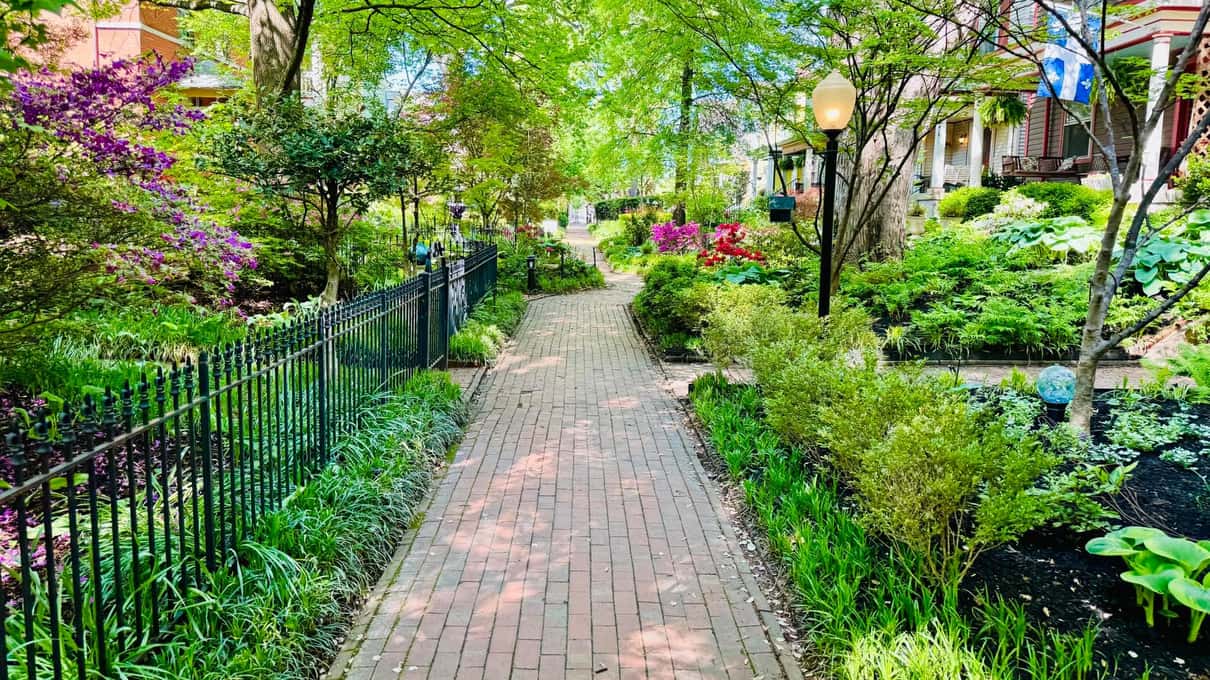
- Belgravia Court. A pedestrian-only court lit by gas lamps, one of the first two walking courts, laid out in 1891. The restoration of its homes in 1961 was an early sign of the neighborhood's revival;
- Fourth Street. A row of grand houses, among them five mansions that the Visitors Center's tour listing says were built for a Victorian jeweler, near the spot where President Chester Arthur opened the Southern Exposition in 1883;
- Magnolia Avenue to Third Street. Walk east along Magnolia to 3rd Street, the stretch locals call Millionaires Row, with the Bernheim Mansion among its showpieces. The Visitors Center's own tour spends half an hour here, and you could too;
- The Filson Historical Society. Kentucky's historical society occupies the Ferguson Mansion on 3rd Street, built between 1901 and 1905. Its exhibits keep their own opening days, so check before planning a visit inside;
- Floral Terrace and the Witches' Tree. Head back west, find the small Floral Terrace walking court on your map, then the gnarled Witches' Tree at Sixth and Park. From there Central Park is a short walk away.
Short on time or energy? Turn back after Belgravia Court and Fourth Street. That shorter loop still takes in the fountain and the castle, and drops only the long leg out to Third Street and the walk back west. You can always add Millionaires Row another morning, or see it on a guided walk.
House rules for the courts
The walking courts are public walkways, but the houses along them are private homes with people living inside. A few habits keep the welcome warm.
- Stay on the path. Gardens and porches belong to the owners, however inviting they look;
- Look at facades, not into rooms. Photograph the turrets and stained glass, but do not press up to a window;
- Keep voices down. The courts are quiet by design, and sound carries between houses set this close together;
- Mind the evening. After dark the gas lamps look lovely, but residents are home and the sidewalks are harder to read.
What a guide would add
Anyone can see the facades. The stories are harder to find on your own. On the history walk, guides explain which family built which house and where the money came from. They also lead you down garden paths most visitors would miss, naming each style on the way. Without them you see a lovely street; with them you learn why a tanner built a castle and how a whole district fell and recovered. How to read a Victorian facade gives you some of that eye for free, and what a walking tour costs shows how little the guided version asks.
The same pavilion, with a guide
The Visitors Center's own 90-minute walk leaves from the building where you pick up the map, from ~$20, with bottled water and a hand fan included and free cancellation until 24 hours before. It is stroller friendly but not suited to wheelchairs.
An app for the ghost stories
We found no self-guided architecture app for Old Louisville on either booking site. The one app option is WalknTours' smartphone ghost walk, ~$9.75, which plays location-aware audio as you pass St. James Court and the Witches' Tree, starting any time and lasting 50–70 minutes. Its record is thin at 12 reviews, and it tells ghost tales rather than explaining the buildings. For the guided version of those stories, read Old Louisville ghost walks, explained.
When to walk on your own
Daylight shows the houses best. Spring brings redbuds and azaleas to the courts. In November the bare trees reveal facades that leaves hide all summer, which makes late fall a favorite for photographers. Avoid the first full weekend of October if you want quiet, because the St. James Court Art Show fills the courts with stalls and crowds. The best time to walk Old Louisville goes month by month.
Old Louisville is a lived-in city neighborhood, with mansions next to apartment blocks, so use the same sense you would anywhere after dark. Finish around lunchtime and what to see after your walk suggests where to go next.